
The Glory of Blue: Native Delphinium and Camas in Seattle, the Eastside, and Camano Island

The Arrival of Blue in the Spring Garden

The Arrival of Blue
There’s a moment in early May when the garden resolves into color.Right now, that color is blue—native Delphinium in full bloom, with Camas just beginning to rise alongside it. In Seattle, the Eastside, and Camano Island, native Delphinium and Camas move through this early May window together, creating one of the most regionally specific bloom moments of the year.
Blue is an uncommon color in the landscape. What reads as blue is often a shift toward violet—pigments bending the spectrum rather than fully occupying it. That’s part of what makes this moment so distinct.
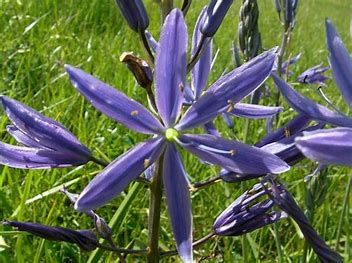
The tones are close enough to feel intentional, even when they’re not—Menzies’ Delphinium (Delphinium menziesii), Nuttall’s Delphinium (D. nuttallianum), Common Camas (Camassia quamash), and Great Camas (Camassia leichtlinii) entering the sequence. Last week, just before dusk, an Anna’s hummingbird fed at the Delphinium—and in that moment, the garden felt less like composition and more like participation.
The pairing isn’t exact, which is what makes it work.
Delphinium carries a more saturated, almost electric blue. Camas—both Common and Great—moves through softer and deeper variations, sometimes leaning violet, sometimes pale sky. Together, they create a layered field of color that feels grounded in place.
At the lower edge of that composition, Baby Blue Eyes (Nemophila menziesii) threads through the garden with one of the clearest true blues of the season. Like Delphinium and Camas, it’s native to the region, but as an annual it appears more lightly—less structural, more fleeting.
Even plants that read as blue don’t always hold that color. Rhododendron ‘Blue Baron,’ in bloom now, often shifts toward violet depending on light and context—another reminder of how uncommon a clear blue actually is in the landscape.
Great Camas, in particular, brings height and structure—taller, more architectural than Common Camas, with a presence that holds the composition longer into the season.
This is not a long performance. But it is a decisive one.
Ecology
That hummingbird visit wasn’t incidental. In Seattle, the Eastside, and Camano Island, native Delphinium and Camas are part of an early-season ecological sequence—nectar, insects, and structure aligning at the same time.
In this region, Camas once formed entire blue meadows, supporting both human and ecological systems. That history still echoes in how these plants function today.
And that’s where this begins to connect more deeply.

Design Insight
What “Lakamas” Actually Points To
The name Lakamas comes from a regional word for Camas—rooted in Chinuk Wawa and tied to the cultural and ecological significance of these plants.
Camas isn’t just a flower. It’s structure, timing, and continuity. It’s one of the clearest examples in this region of how landscape, ecology, and human history are intertwined.
That idea sits at the center of the work.
Not just planting for appearance—but building landscapes that function as systems, where timing matters, where bloom sequences support life, and where what you see is only part of what’s happening.
Designing With Native Delphinium and Camas in Seattle, the Eastside, and Camano Island
Designing With Delphinium and Camas
Place early bloom where it can be experienced—entries, primary views, daily paths
Pair species that bloom together to create a cohesive seasonal moment, not isolated color
Use structural plants like great camas to extend presence beyond peak bloom
Let these moments be part of a larger sequence, not the entire story
This is how a garden moves from decorative to deliberate.

Designing Landscapes That Reflect Place
The blue of Delphinium and Camas is brief—but it’s not random. It’s part of a pattern that can be designed, reinforced, and extended.
At Lakamas Landscape Design, we approach landscapes as composed systems—where structure, planting, and ecology work together over time.
Explore our Landscape Design services to learn more.
Copyright © 2026 Lakamas Landscape Design. All text and photographs are the property of Lakamas Landscape Design unless otherwise credited.

Comments