
How the Vine Maple (Acer circinatum) brings Autumn Color to the Landscape in Seattle and Camano Island

Updated: Mar 4
Vine Maples Have Beautiful Fall Color But Are Beautiful in All Seasons

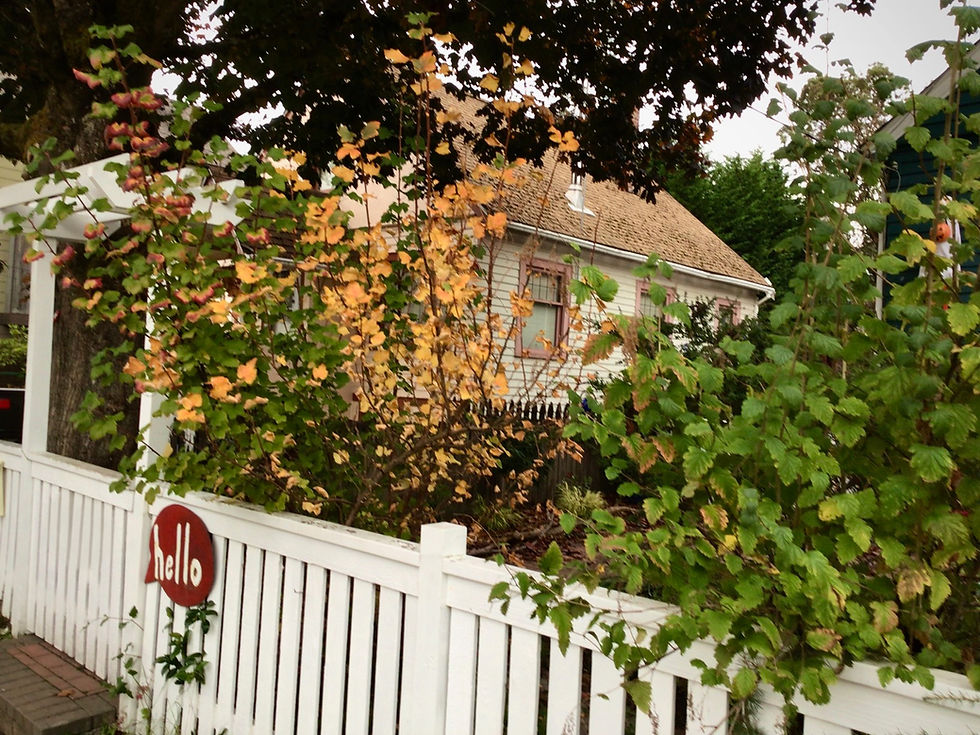
It's fall, and what a great time to talk about Vine Maples (Acer circinatum). This small tree is perfect for an urban or suburban yard, or really, just about any yard. It does everything you ask of it - fall colors of orange, reds and yellows, and I'd say just as wonderful, lime green spring leaves that unfurl with red petioles and samaras (those adorable winged seeds). I love the color contrast, which makes my little designer heart go all aflutter. Additionally, this is a native tree to the Pacific Northwest!
Compared to Japanese maples, I'd say it's a little more rustic and wilder looking, not quite as refined as the Japanese maples that have been bred for centuries to get where they are today. I love the 'straight' species, but there are some cultivars (also called 'nativars' = cultivar+native) that will fit into just about anywhere - see the link below. Although I haven't grown the Pacific Fire variety myself, it looks comparable to a Coral Bark maple (red bark and yellow fall color with lime green spring color).
Vine Maple (Acer circinatum)
Common name: Vine Maple
Origin: Native to the Pacific Northwest — from British Columbia to northern California
Size: Typically 10–20 ft tall × 10–15 ft wide (occasionally taller in shade)
Form: Multi-stemmed small tree or large shrub
Hardiness: USDA Zones 5–9
Overview
Graceful, adaptable, and quintessentially Northwest, the Vine Maple (Acer circinatum) is one of our region’s most beloved native trees. Found naturally in forest understories, along streambanks, and on the edges of woodlands, it provides structure, dappled shade, and seasonal color that blend seamlessly with the surrounding landscape.
In spring, fresh green or chartreuse leaves emerge on slender, arching stems. Summer brings a tranquil canopy of layered foliage that filters light beautifully, and fall transforms the tree into a glowing mass of red, orange, and gold. Even in winter, its branching silhouette adds sculptural interest to the native garden.

Features
Bark: Smooth, light green to reddish-brown on young stems
Leaves: Rounded, 7–9 lobes; bright green in spring → deep green in summer → fiery red/orange/yellow in fall
Light: Part sun to full shade; tolerates more sun in cool coastal or moist sites
Soil: Prefers moist, well-drained soils rich in organic matter; tolerates clay and sand if drainage is good
Water: Appreciates consistent moisture; drought-tolerant once established
Maintenance: Minimal; remove any crossing or damaged stems after leaf drop if needed
Design Uses
Vine maple is exceptionally versatile. In naturalistic gardens, it bridges the canopy and understory layers, thriving beneath tall conifers or mixed with ferns, Oregon grape, and salal. In more designed spaces, its arching multi-stemmed form provides elegance and movement, especially when pruned lightly to emphasize structure.
It performs beautifully on woodland edges, shaded slopes, or rain gardens, where its seasonal shifts complement moss, rock, and evergreen foliage. In full sun (particularly west of the Cascades), it grows denser and develops the strongest fall color, while in shade it stretches gracefully, creating sculptural lines.
Ecological Value
As a native species, Vine Maple plays an important role in Pacific Northwest ecosystems. It provides shelter and nesting sites for small birds, its early flowers attract pollinators, and its seeds feed native wildlife. The dappled canopy it creates helps moderate soil temperature and moisture — ideal for maintaining understory plant diversity.
Because it regenerates easily from seed and resprouts from the base, it’s also valuable in restoration and reforestation projects, stabilizing slopes and providing a nurse canopy for other species.
Why We Love It
Few trees capture the spirit of the Pacific Northwest like the Vine Maple. It’s beautiful in every season — fresh in spring, luminous in fall, and sculptural in winter. Its graceful, layered form and ecological value make it an essential choice for designers who want to create gardens that are both natural and enduring.
Design Companions
Western sword fern (Polystichum munitum)
Evergreen huckleberry (Vaccinium ovatum)
Oregon grape (Mahonia aquifolium or Mahonia nervosa)
Salal (Gaultheria shallon)
Red-twig dogwood (Cornus sericea)
Inside-out flower (Vancouveria hexandra)
Design Begins with Thoughtful Plant Choices
We invite you to explore our design services to see how your garden can be elevated.

Photo References
Photos by Clay Antieau, used with permission

Comments